
What makes an aerodrome controlled?
An ATC unit (Tower, sometimes with Ground and Approach) and usually a control zone (CTR) or aerodrome traffic zone. VFR flights need a clearance to enter controlled airspace.
Contacting ATC and entering the zone
Routes, levels and codes are illustrative. Use the published VFR routes and reporting points.
Clearances and readback
Read back clearances and instructions to enter, land on, take off from, hold short of, cross or backtrack on a runway, plus levels, headings, QNH, squawk codes and frequencies. See aviation readback.
Taxi, holding point and line up

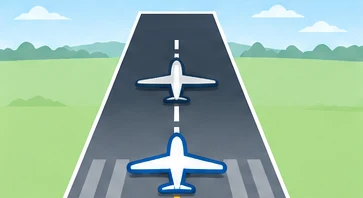
Take-off and leaving the zone
Common mistakes
- Entering a zone after "pass your message" but before a clearance.
- Crossing a holding point without clearance.
- Treating line up as take-off clearance.
- Missing the condition in a conditional readback.
Frequently asked questions
Is "line up and wait" a take-off clearance?
No. Take off only after "cleared for take-off".
What if I miss part of a clearance?
Ask "say again"; never guess a runway or level.
Do I always get a squawk?
Often in controlled airspace. Read it back and set it.
Sources
- CAP 413 Radiotelephony Manual (Edition 24, effective 1 July 2026) – UK CAA
- UK Regulation (EU) No 923/2012 (UK SERA), Section 14 Voice communication procedures
- UK AIP (NATS Aeronautical Information Service), incl. ENR 1.1 and AD 2
This is training information, not operational guidance. For real flights always use the current UK AIP, NOTAMs and your instructor's instructions.